Week 7: Rapid Ideation session 2 (pt 1)
- Lehang Tieu
- Jul 23, 2021
- 4 min read

Updated: Aug 23, 2021
23rd July 2021
In rapid ideation session two, the theme was to create a prototype that solves a problem in your daily life. Although there was an option to collaborate with another student, I wanted to work independently to focus on my self-development.
Time and project management
I had implemented time and project management well in the last rapid ideation. As a result of this, I wanted to continue this in the next session. I created a similar Gantt chart to organise and structure the two weeks. I wanted to allow for more time in user research and prototyping in Figma. I am worried about balancing enough time for this ideation session with my current job. However, I will try my best to manage my time and effort to complete the activities.

Gantt chart image created by Lehang Tieu. 2021.
The Gantt chart has helped to structure the rapid ideation session. It allowed me to see a clear overview of the upcoming tasks. I timeboxed each activity by giving a start and end date to ensure enough time to complete each one. One of my strengths is keeping organised therefore it was easy to create a plan and stick to it. Organisation is a skill that I will be applying in all the modules of the Masters which will help me prepare for my future career.
Mash-up
I used the mash-up technique to generate ideas using the Miro software which is an online collaboration tool. Mash-ups involve brainstorming ideas from two different topics. I have chosen problems in my daily routine and leisure. I gave myself 20 minutes to brainstorm and 10 minutes to combine innovative and fun concepts. From this method, I have decided to create a budgeting app to control your spending. I enjoyed using this technique for the first time as it was spontaneous and entertaining compared to the standard brainstorming technique.

Mash-up image in Miro created by Lehang Tieu. 2021.
User research
Interview
I prepared interview questions to have an understanding of real users that will be using my app. I interviewed two users from different age groups.

User interview image created by Lehang Tieu. 2021
In summary of the interviews, I got a better understanding of users looking to budget their money. I have learnt users watch what they are trying to spend but would like to improve their budgeting by limiting expenditure. They also have goals they would like to achieve in the future.
My target audience is users ages 22+ who are currently working and are looking to save money whilst having short-term and long-term goals. The interview process has helped me to refine my idea for my artefact.
The most common reason why people budget is because they are spending more than they are saving. They want to save more money and control their spending. The benefits of budgeting include managing your finances, track your spending, achieve financial goals and help you identify any money issues and overspending. I have benefitted from budgeting because it gives me an allowance of what I can do with my money once I have paid all my bills and contributed to my savings. It also forces me to make cutbacks and consider if I need to spend money on something or not.
User journey
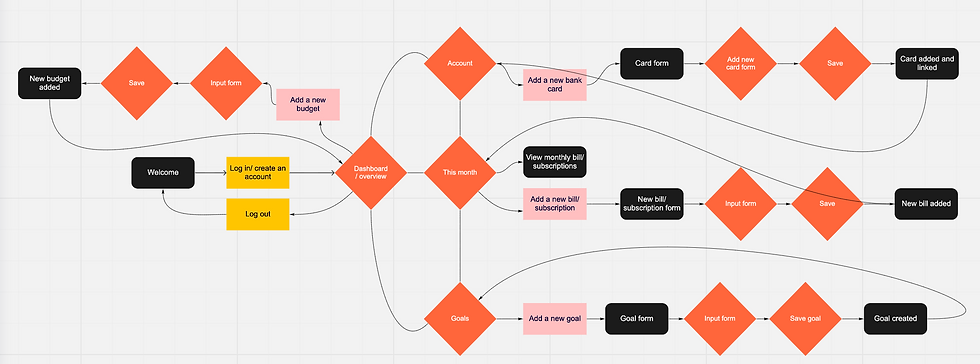
User journey image created by Lehang Tieu. 2021.
I have created a user journey of the app to visualise the process and flow the user will experience. The user will log in or create an account to access their dashboard that displays their balance and monthly budgets. They will have the option to view this month's bills, link their card to their account and create short-term and long-term goals. My focus for the app is the goal calculator feature. The user can make goals by adding a desired amount and deadline that generates an approximate amount they will need to save each month. These goals will help the user become money conscious and they will create budgets to achieve them.
Summary
To summarise this week, it has been smooth so far. Experiencing the first rapid ideation has given me a better understanding of what to expect in this session. It gave me room to improve my processes and take onboard the successes in future sessions. Sometimes I struggle to get out of my comfort zone but I enjoy trying new things. I used this opportunity by implementing the mash-up technique and creating a user journey using Miro. Although I didn’t use Miro to collaborate with others, I can use this in future group projects. It was my first time designing a user journey and it allowed me to understand and step in the shoes of my users. It also creates a streamlined customer experience by predicting the user's behaviour. User journeys are something I would like to explore further and perfect in the future and it will help me build my skills in my professional development in UI design.
My next step is to create paper prototypes and branding for the app (logo design, colour palette and fonts). I am excited to explore animation and interactivity tools and hope to create a fully functional prototype.
References
Hyper Island Toolbox. 2021. Mash-up innovation. [online] Available at: <https://toolbox.hyperisland.com/mash-up-innovation> [Accessed 18 July 2021].
Cabot financial. 2021. What are the benefits of budgeting? | Cabot Financial. [online] Available at: <https://www.cabotfinancial.co.uk/money-management/money-management/what-are-the-benefits-of-budgeting> [Accessed 18 July 2021].
Money Saving Expert. 2021. The Budget Planner. [online] Available at: <https://www.moneysavingexpert.com/banking/budget-planning/> [Accessed 18 July 2021].
The Balance. 2021. Your 6-Step Guide to Making a Personal Budget. [online] Available at: <https://www.thebalance.com/how-to-make-a-budget-1289587> [Accessed 18 July 2021].


Comments